Agentic OS Dashboard
The terminal this studio
actually runs on.
Seven surfaces, six themes, full source. You bring the data. Your agent does the wiring.
Install, seven surfaces, six themes, then one edit to config.js changing the operator and the currency.
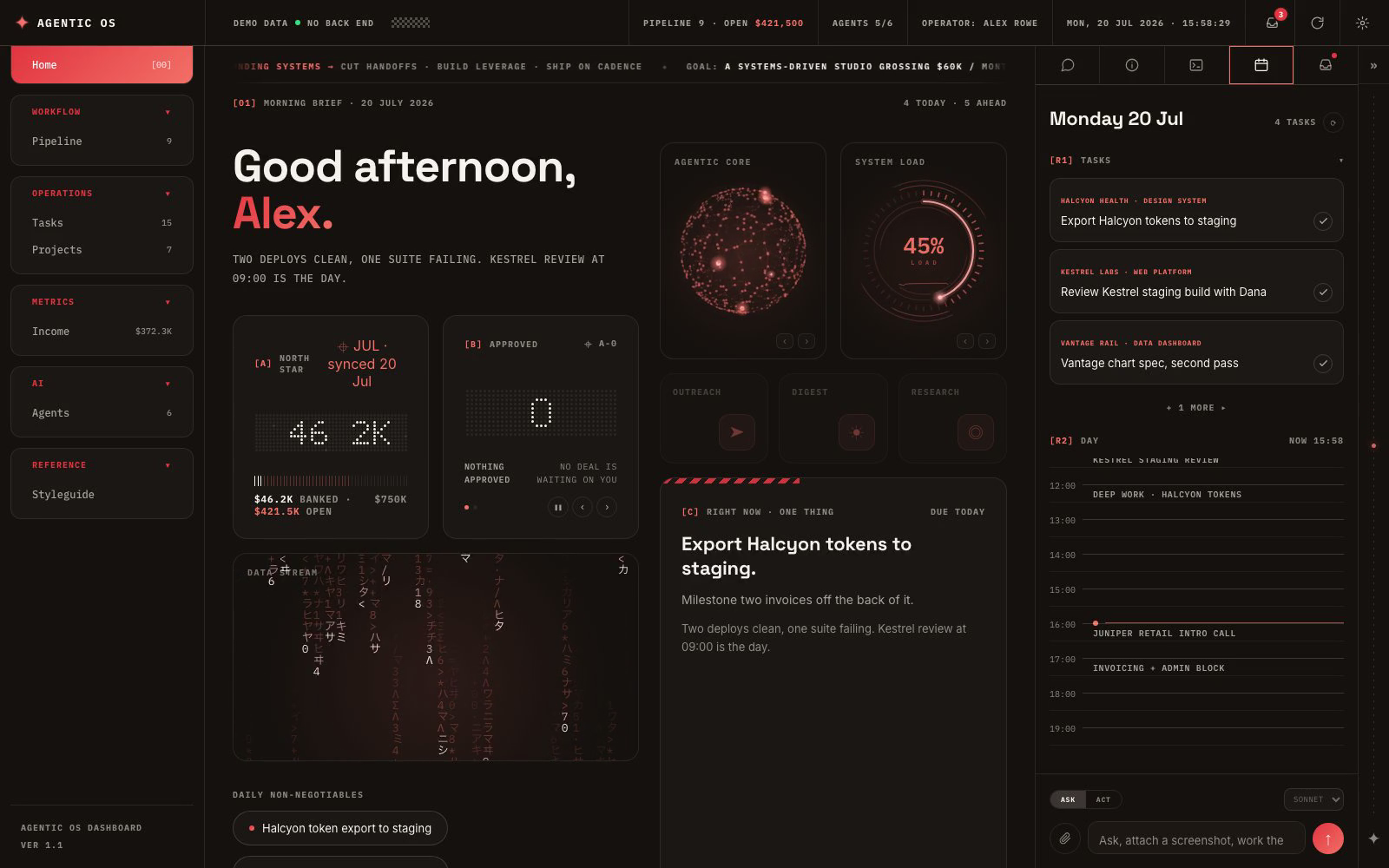
This is the dashboard.
Not a template. Not a component library. The operator surface, built and run daily before it was ever sold.
Home, Pipeline, Tasks, Projects, Income, Agents, and a Styleguide that documents the whole system. Dot matrix numerals. Mono data labels. Full-border status marks. A chat rail that stays put while the pages change under it.
That serves the kit and bridges the chat rail to the Claude Code CLI, which it expects on your PATH. Open the URL it prints. If you only want to look around, any static server does, and chat is the one thing that will not work.
Either way it opens with a full demo dataset already in it. You can judge it in ten seconds.
The problem is taste, not skill.
You already build your own tools. That is not the hard part.
The hard part is that they keep coming out looking the same. Default spacing. Default type. Someone else's judgement compiled into a component library. You can see it is generic. You cannot spare three days working out why.
You are not short of ability. You are short of the week it takes to get an interface from correct to good.
and the fastest thing to copy.
Seven surfaces.
Cut from twenty-three. Every one of them earns its place.
Home
The morning brief. What is on today, what is approved, what is burning.
Pipeline
Deals by stage, open value, what each one is waiting on.
Tasks
Today and the backlog. Tick, drag, reorder.
Projects
The portfolio, open value by status, fees against dates.
Income
Revenue by month against target, banked against received.
Agents
Runners, schedules, run log. Green when clean, red when not.
Styleguide
The system itself. Type scale, spacing, and every locked component pattern, so anything you add stays coherent with everything already there.
Six themes and five wallpapers, per device, saved between reloads.
You bring the data.
There is no server in the box. That is the design, not a gap.
You already have your data, and it is the part you actually care about. Shipping you a back end would mean shipping you a migration.
Instead the kit ships a fixture layer. Every page calls an API that is not there, and the fixtures answer from JSON files. Those files are the specification: whatever state.json looks like is what your endpoint has to return.
The fixtures try the network first. So as you stand up real endpoints one at a time, each one starts winning automatically. Nothing to switch off. No half-wired state to manage.
Your data stays where it is. The kit comes to it.
Your agent does the wiring.
SKILL.md is written to your coding agent, not to you.
It sets the contract. What a page is in this system. What must never be edited. How to add a surface without breaking the shell. How to prove you have not leaked a listener across a page mount.
Open Claude Code in the folder and say:
That is the whole workflow. It is also the part you will enjoy.
What you need.
You run Claude Code daily. You have your own data. You are comfortable standing up your own endpoints.
If you want something hosted that works out of the box, this is the wrong purchase, and I would rather you knew that now.
What you keep.
Buy once, own the files. Edit it as far from the original as you like.
Latest: v1.1, 20 July 2026. Chat works now.
See everything that has shippedNot sure yet? Open the live one.
The demo instance runs the same build you would download, on the same fixtures.
Switch the themes. Drag a task. Break something. Nothing you do there touches anything, and it will tell you more in two minutes than this page will.
Start today.
You can build all of this yourself. You have the skill. What you do not have is the week of taste iterations already spent.
That week is what is for sale.